
What does the Rice Student Birding Club do?
When you say birding, many think of masters with massive telephoto lenses and expensive binoculars. But really, someone taking a picture of a “red bird” with their phone camera is just as much of a birder. There is no exhaustive list of things a birder can do: learning field-marks that allow one to identify birds, going on trips to wildlife reserves, drawing and painting birds, or setting up a backyard feeder.
We have two main purposes: providing a free birdwatching experience for students of all ages and experience levels, and dedicating conservation efforts toward protecting birds.
“The beautiful thing is that a beginner can jump in and appreciate birds as much as someone who has been birding since they were 5. I started a year ago and it changed my life. —Shanti M., Martel ‘29”
Birdwatching:
Our goal is to make birdwatching as accessible and enjoyable as possible by eliminating traditional barriers like high equipment costs, unfamiliarity with species, and hard-to-find locations. To help both beginners and experienced birders focus on the joy of the hobby, we provide free binocular loans, weekly guided campus birdwalks, fully sponsored off-campus trips, and a supportive community centered on friendly vibes and helpful spotting and identification tips.
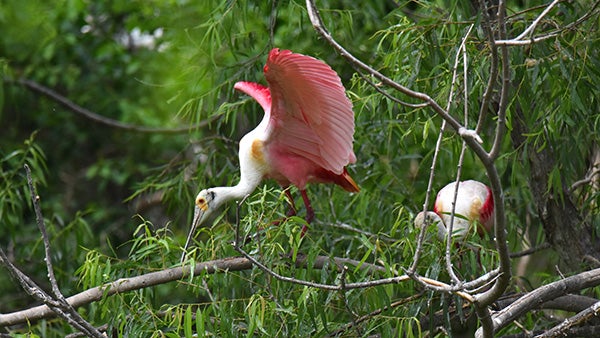
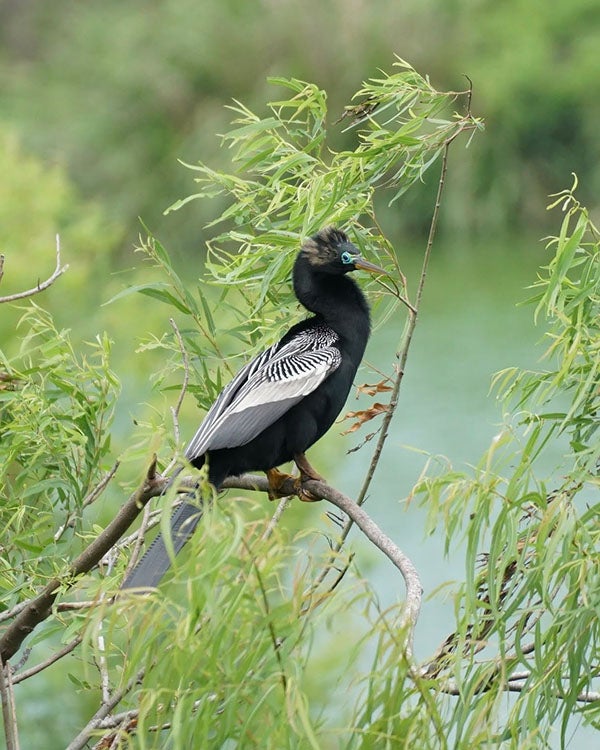
About twice a semester, we take an off-campus trip to one of the many amazing birding spots near Houston, sometimes venturing outside the area. We’ve seen tons of waterbirds and songbirds on trips to Anahuac / Jocelyn Nungaray National Wildlife Refuge, Cullinan Park, and most recently Archbishop Fiorenza Park, all within a 30-to-60-minute drive from campus. Recently, we teamed up with RAW Photography Club for an all-expenses-paid trip (plus lunch!) to Archbishop Fiorenza Park, where we saw about 30 species. We walked around for half a day and spotted Cormorants, Great Egrets, Roseate Spoonbills, and other waterbirds.
We’ve also collaborated with Birds Houston, the local birding society. We recently co-hosted Swift Night Out with them, watching a colony of at least 300 Chimney Swifts funnel into the Tudor Fieldhouse chimney.
Conservation:
For conservation, we primarily focus on window strikes. Birds don’t recognize human visual cues like smudges or sheen. They see reflections of trees and think they’re flying in the natural environment, crashing into glass at high speeds—often fatally. We prevent this by installing bird-friendly window stickers: mostly clear sheets with spaced white dots that provide a visual warning. We collect data from volunteer surveyors and students about dead birds found on campus, all automated through our website, and send it to a professor at UT Austin. This unique window coating is already on the windows of New Lovett, Chao, and Anderson Biological Laboratories, but we hope to add it to taller, glass-heavy buildings with high collision frequencies, such as O’Connor, Sid Rich, and the BRC. Anyone can volunteer to collect survey data for just 90 minutes, or simply submit a quick report at https://ricebirding.org/report. The site asks for a couple photos (close up and far away) and whether the bird is injured or dead. Identifying the species is optional.
What kinds of birds can you find on campus? Are there any rare species your members have found?
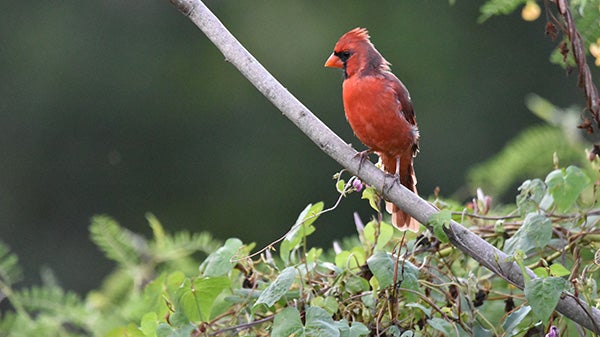
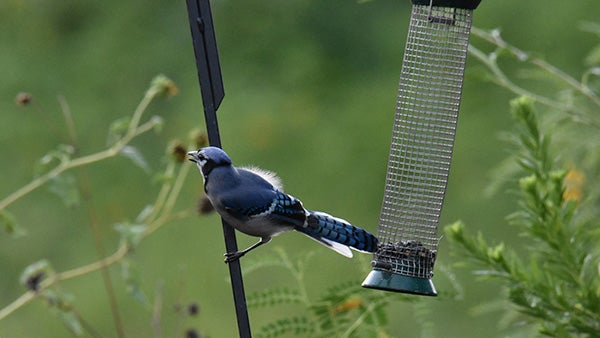
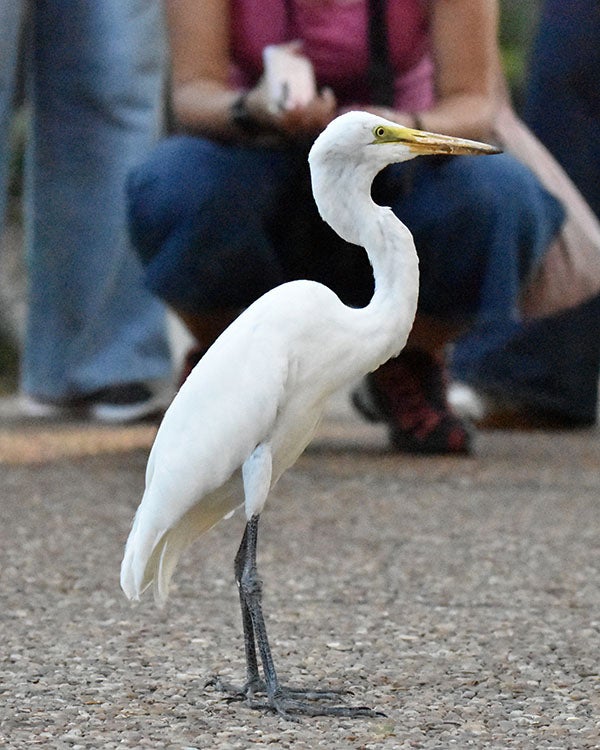
The most common birds on campus are Great-Tailed Grackles—quirky, shiny black birds that make squawking or crackling sounds and are sometimes missing tail feathers due to molting. You’ll also hear Blue Jays before you see them! At the Owl Deck, a structure in the preserve by Intramural Field 6 and Wiess College, we see tiny birds like Ruby-Throated Hummingbirds, Scaly-Breasted Munias, and House Sparrows; medium birds like Northern Mockingbirds, Northern Cardinals, and Downy Woodpeckers; and large birds like Red-Shouldered Hawks! There’s also a medium white bird called the Great Egret (ornithology codename GREG :)) that’s become a bit of a campus celebrity!
For rare species, Rice sits along a migration path, so we’ve seen tons of warblers (including Golden-winged, Mourning, and Magnolia Warblers), cute wrens (tiny brown birds with big attitudes), tiny hummingbirds like Allen’s Hummingbird, and rare raptors like Kestrels and fish-eating Ospreys. These birds appear near Huff House (east campus) and the Owl Deck (south campus). Other notable rare sightings include the Brown Booby, Wood Stork, and Smith’s Longspur!
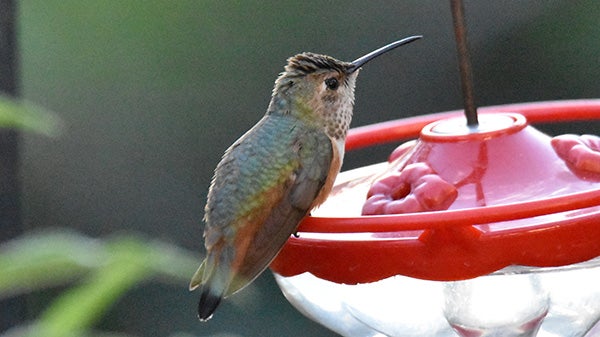
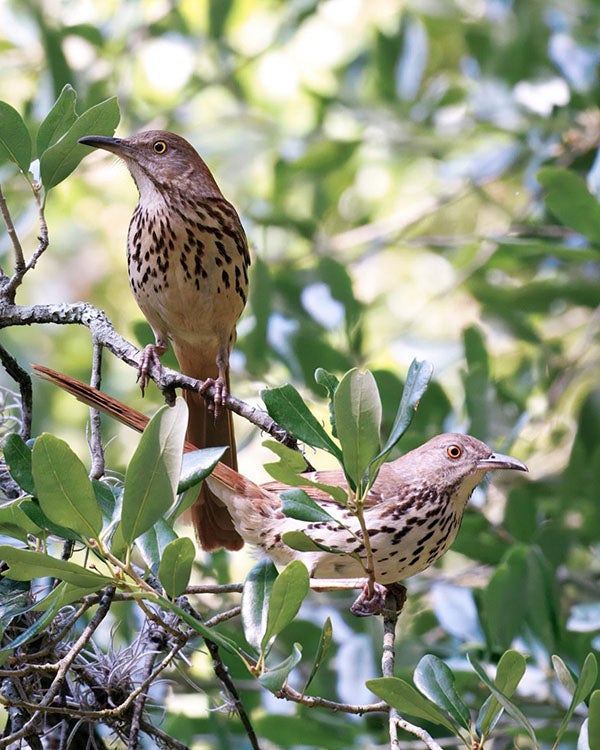
The rarest finds have been hybrid birds! We’ve seen two unique combinations: a Long-billed Thrasher mating with a Brown Thrasher, and a Black-chinned hummingbird with a Ruby-throated one!
The Thrashers were the coolest story on campus this past summer! Both species belong to the genus Toxostoma but diverged genetically millions of years ago. Neither species is typically spotted in Houston, so seeing both simultaneously was unheard of—let alone mating! They broke species taboos to produce a chick, which would have been the first documented hybrid between these species. Their first nest succeeded, though the fledgling was quickly dispatched by Rice’s militant squirrels. Their second nest failed to hatch. Even without a successful brood, this nest was one of the craziest bird romances of all time, attracting hundreds of birdwatchers from Greater Houston.
How do the birds on campus add to the Rice atmosphere?
Since Rice is an arboretum, birds serve as a constant reminder of our rich campus environment. Walking to classes surrounded by bird calls offers a relaxing moment before focusing in class. It actually feels strange to step outside and not hear a Blue Jay calling!
For me (Julihannah L., Hanszen ‘28), birds enhance campus quality of life alongside the beauty of Rice’s live oaks. Beyond the flora, you have cute birds hopping through the trees. On any given day, Blue Jays are calling to their mates, Great-Tailed Grackles are foraging for food, Chickadees are chirping in the trees, or hawks and vultures are soaring overhead. Birds are always on the move and easy to spot and hear. Even when I’m rushing to class, hearing their calls and seeing them move around makes campus more lively and enjoyable.
“The Birding Club and Rice faculty have logged 277 bird species on campus so far, and counting!”
Have you guys ever spotted an owl on campus (and did you get a picture)?
We have spotted many owls! There is a mating pair of Great Horned Owls near Huff House, and Eastern Screech Owls are comfortable enough around humans to get close at night. I (Shreyashi B., Martel ‘30) have seen one just 3 feet away from me in the Martel quad oak tree.
What do you enjoy about birding?
I (Shreyashi B., Martel ‘30) enjoy stepping away from academic rigor and devices to observe my environment. As a newcomer to Houston, I love learning about local birds — their calls, quirks, and behaviors. I also enjoy the community; birders are incredibly passionate people. It’s an amazing feeling to spot a cool bird while surrounded by people who are just as awed and excited!
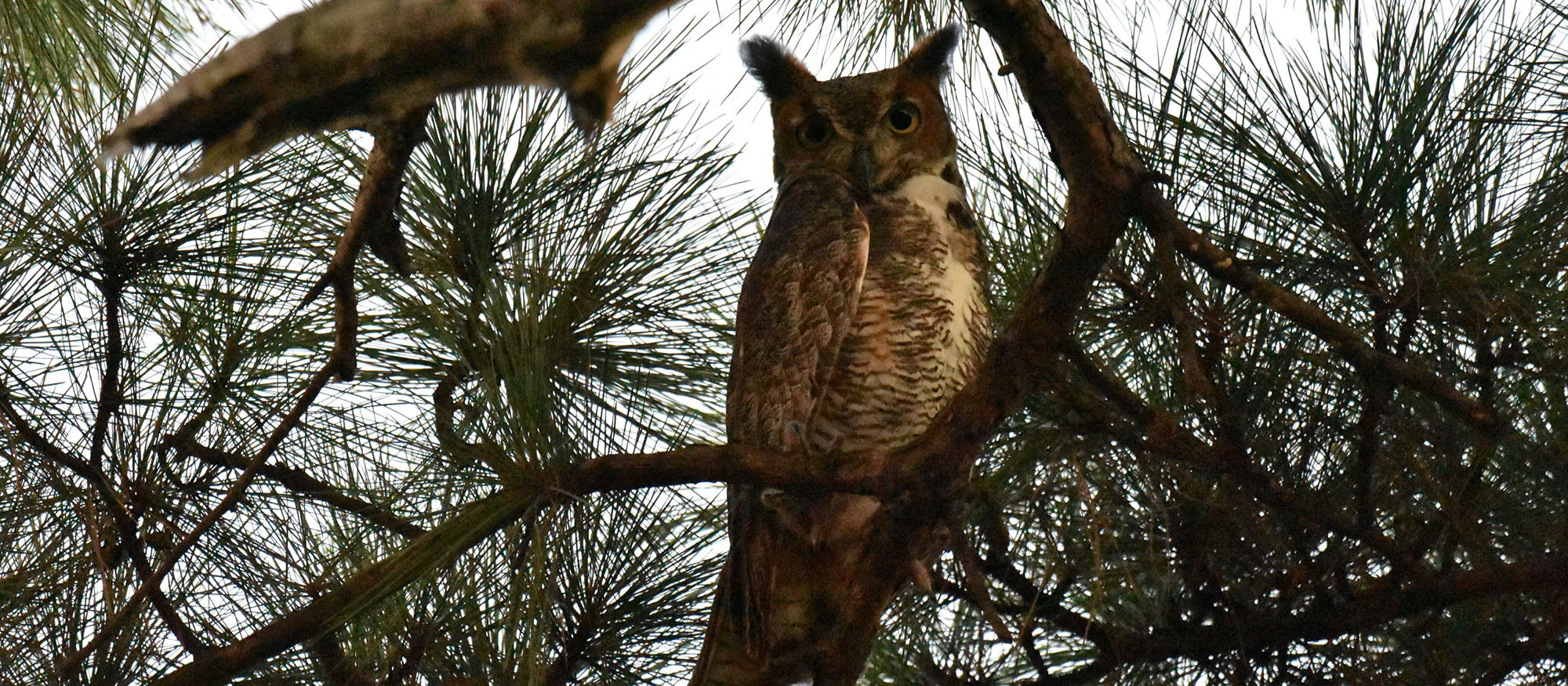
-Rice Student Birding Club (Published on 11/10/26)
Keep Exploring
When I (Phoebe S., Hanszen ‘28) first arrived at Hanszen College for O-Week, I didn't expect to make new friends on my very first day! But fast forward a year later, and I found myself serving as an O-Week Coordinator on the other side of orientation. O-Week is a key part of how community is built at Rice, and setting the tone for a new class of Owls was truly a full-circle experience!

Representing Rice on a national stage is always amazing, but heading to the SASE National Conference in Seattle felt extra special because it marked a huge milestone five years in the making! As Internal Vice President of Rice SASE, I (Gayla G., Sid Richardson ‘29) had a front-row seat as our chapter connected classroom theory with real-world engineering in real time. Here’s a look inside our experience and the community we are building on campus.
If you’d told high school me that a single campus visit would overrule my neatly coded college spreadsheet, I (Lucy C., Lovett ‘29) never would’ve believed you! But looking back on Owl Days 2025 at Rice, that warm afternoon wasn’t just another stop on the tour — it was the moment I found my home.
Helpful Links
713-348-7423
admission@rice.edu
M-F 8:30 a.m. to 5 p.m. CT